Available Now
Optimized for Yesterday
What Happens When the Scarcity Changes
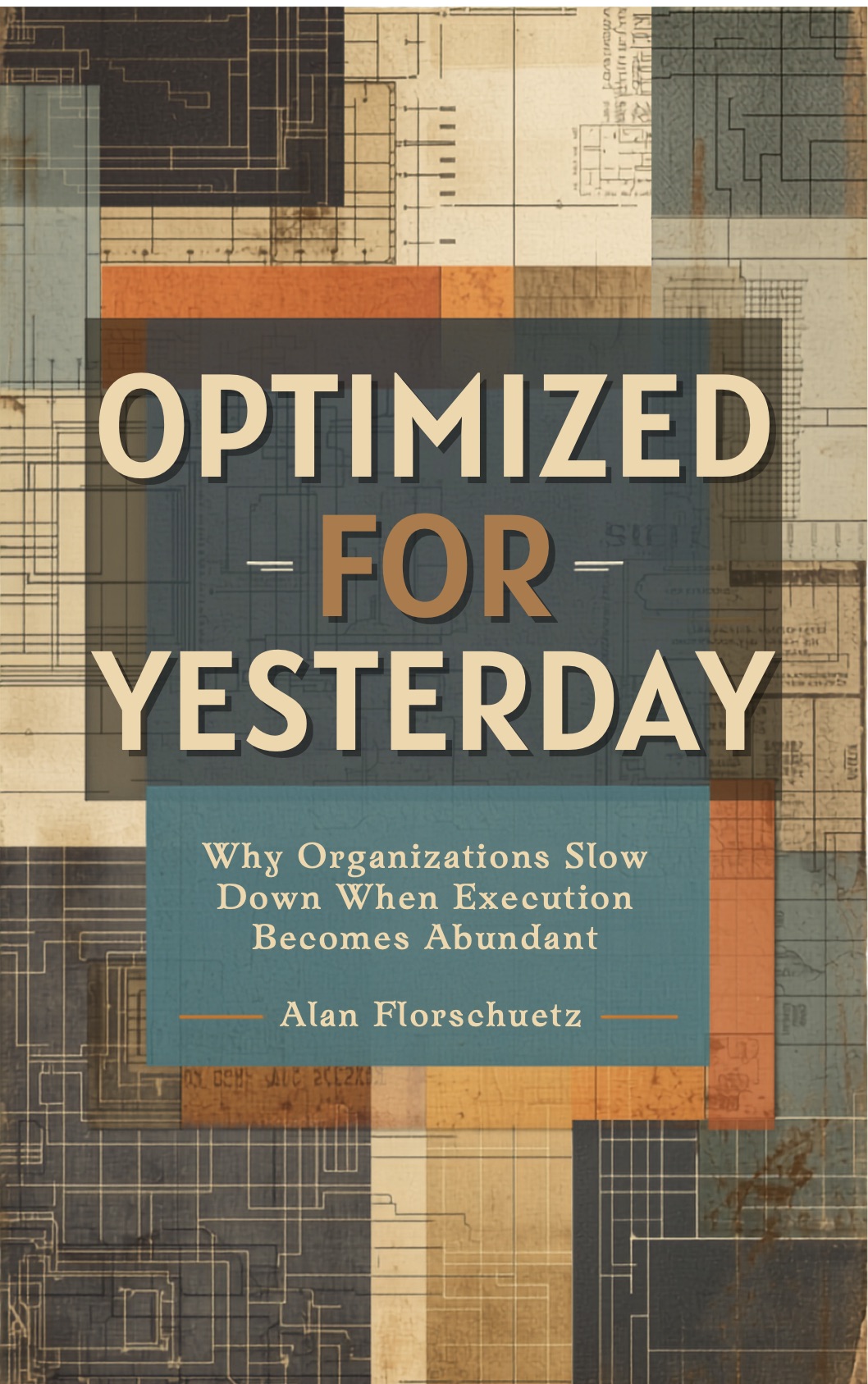
For decades, management science optimized organizations around a single assumption: execution is expensive. Every structure — sprints, committees, approvals, roadmaps — exists to prevent waste in a resource-constrained world.
That assumption is now wrong.
This book presents the economic proof that abundance requires a fundamentally different operating architecture, and provides the complete framework for building one.
What's Inside
Ten chapters move from diagnosis through architecture to deployment — connecting the mechanisms explored in the working papers into a unified operating model:
Introduction: The Friction Crisis
- The Invisible Gravity The forces that hold organizations in place even when everyone agrees they should move faster.
- The Cost of Certainty Why the pursuit of predictive confidence becomes the most expensive activity in the enterprise.
- The Infinite Review Loop How abundant analysis creates a new pathology: endless refinement that never reaches commitment.
- The Coupled Enterprise How organizational dependencies compound into structural drag that no single team can resolve.
- The Amplified Sovereign The economics of the individual amplified by intelligence, and what it means for how work is organized.
- The Human Transition What happens to expertise, leadership, and collaboration when the economic foundations shift.
- Bounded Governance How to maintain safety, compliance, and alignment without committee overhead.
- Capacity Funding A new model for how organizations allocate resources when estimation becomes unreliable.
- The Evidence Loop Replacing predictive planning with continuous learning from production reality.
- The Autonomous Horizon Where this trajectory leads and what the continuous organization looks like.
Appendix: The Abundance Operating System Blueprint
Who This Is For
- CTOs and VPs of Engineering watching delivery velocity plateau despite investment
- COOs managing organizations where coordination cost exceeds production cost
- Transformation leaders seeking a framework beyond Agile and SAFe
- Individual contributors who sense the system is the bottleneck, not their talent
- Board members and investors evaluating organizational readiness for AI-era economics
Built on Working Papers
Every chapter is grounded in original research — the Project Intent Working Papers series. The papers introduce individual mechanisms. The book reveals how they interact as a system.
Read the public editions →Get the Book
Available now in paperback and Kindle edition.
Buy on Amazon →ISBN: 979-8-9971259-0-5 | Published by Project Intent
The OrgOS Framework
The book provides the worldview and the architecture. The appendix contains the evolving OrgOS implementation blueprint — a practical operating framework for enterprises ready to transition.
Self-guided implementation tools are in development.
Explore the Framework →